

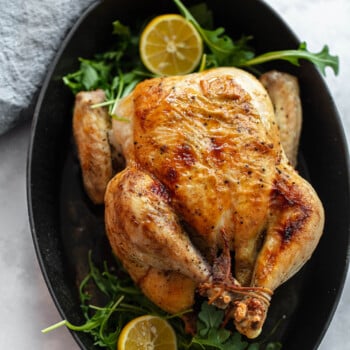
Herb-Roasted Whole Chicken (Crisp Skin, One Hour)
This post may contain affiliate links. Please read my disclosure policy.
I’ve roasted more whole chickens than I can count — in restaurant kitchens, as a personal chef, and at home for my own family. A properly roasted bird is one of those deceptively simple tests of cooking confidence. Get the heat right, don’t fuss with it, and you end up with crackling skin and meat so juicy it practically carves itself. This version starts with Marcella Hazan’s brilliant lemon chicken as the foundation — a whole lemon, punctured and tucked into the cavity, and a handful of herbs perfumes the meat from the inside out as it roasts.

What goes into this chicken, and why

- The chicken: I use a 3–4 pound fryer, not the larger birds labeled “roaster” at the grocery store. A smaller bird cooks more evenly at high heat — by the time the thigh is done, the breast hasn’t dried out. A 5-pound bird is harder to get right with this method — the outside colors faster than the inside cooks, and it will take longer to finish cooking.
- The lemon: Puncture it about a dozen times with a skewer before it goes in the cavity. As the bird heats up, the lemon releases steam and juice directly into the meat, basting it from the inside. When you carve the chicken, the juices spill out and make a natural pan sauce. When I skip this step I notice the difference.
- Kosher salt: Use more than feels comfortable. I typically use about 4 teaspoons for a 3–4 pound bird. I use Diamond Crystal, which is coarser and less dense than Morton or table salt, so the measurement isn’t interchangeable by volume. If you’re using Morton kosher or fine sea salt, cut back to about 2½ teaspoons. Seasoning generously — inside the cavity and all over the skin — is what keeps the meat juicy and gives the skin flavor all the way through, not just on the surface.
- Fresh herbs: Rosemary and thyme are the most direct pairing here, but tarragon works well, and a mix of all three is ideal. Dried herbs don’t perform the same way in the cavity because the lack of moisture stops the aromatics from releasing. Tuck the sprigs into the cavity alongside the lemon, or slide a few under the breast skin if you want the flavor more direct. Either way works — the heat does the rest.
Why pan size changes everything
You don’t need anything special. The main rule I stick to is using a pan that fits the bird snugly (about 12 inches) without too much empty space around it. A larger pan disperses the drippings and reduces less efficiently. Avoid anything deeper than 3 inches, because a deep casserole-type dish traps steam around the bird, which curtails crisp skin.
Any of these will work:
- A rimmed quarter-sheet pan (12×9 inches) is what I use most often — inexpensive, easy to clean, and the low sides let heat circulate freely.
- A 10–12-inch cast iron skillet.
- 2–3 quart enameled or stainless roasting pan.
- A rack is optional — without one the underside skin steams slightly but the result is still good.
Trussing takes 30 seconds — the only method you need
Trussing the bird keeps the lemon, garlic, and herbs from falling out during roasting. I use the simplest method: Cut a 12-inch length of kitchen twine, loop it around both legs, and tie it securely. That’s it. If you don’t have twine, push a few toothpicks through the skin on either side of the cavity opening instead.
How to roast a whole chicken

The most important technique in this recipe is the two-temperature method: Start the bird at 425°F for the first 25 minutes, then drop to 375°F to finish. The high heat sets the skin and immediately starts browning the skin, while the lower heat finishes cooking the chicken without the breast drying out. Marcella Hazan roasts her lemon chicken at a steady 350°F — it works, but you get less color on the skin.
Remove the chicken from the oven when a thermometer reads 165°F in the thickest part of the thigh, away from the bone. Rest it uncovered for 10 minutes before carving — the juices redistribute and the skin stays crisp rather than steaming under foil.
What to serve with roast chicken
Roast chicken is one of those rare main dishes that goes with almost anything starchy, green, or both — these are the sides I find myself reaching for most:
- Olive-oil mashed potatoes
- Oven-crisp smashed potatoes
- Roasted green beans with shallots
- Sautéed broccoli with garlic
- Easy roasted carrots or buttery glazed carrots
Save the carcass and bones — they make the best homemade chicken broth.
Herb-Roasted Whole Chicken (Crisp Skin, One Hour)
Ingredients
- 1 (1.3 kg) 3-4 pound whole chicken
- 4 teaspoons (55 g) kosher salt, I use Diamond brand or coarse sea salt
- 1 teaspoon freshly ground black pepper
- 1 small head garlic, sliced in half
- 1 small lemon or half of a large one, punctured about a dozen times with a skewer
- 1 handful mixed fresh herbs such as rosemary, thyme, tarragon, or rosemary
- 1 tablespoon olive oil
Equipment
Instructions
- Preheat the oven to 425 (220 C) degrees, for at least 20 minutes. Make sure the oven rack is set in the center of the oven.
- Pat the chicken as dry as possible with paper towels and place in a shallow casserole dish or roasting pan. A quarter-sheet pan is the perfect size for one whole chicken. I don't use a rack, but if you choose to, line the pan with a piece of foil or parchment.
- Put 2 teaspoons kosher salt, ½ teaspoon of the pepper, 1 small head garlic, 1 small lemon or half of a large one and 1 handful mixed fresh herbs such as rosemary, thyme, tarragon, or rosemary into the cavity. Rub the remaining 2 teaspoons salt and ½ teaspoon pepper all over the skin — front, sides and back. Tie the legs together firmly with a piece of kitchen string. Drizzle olive oil into the pan, and turn the chicken breast side down.
- Roast the chicken for 25 minutes. Remove the chicken from the oven and carefully turn it so the breast is facing up. Put it back into the oven, turn the temperature down to 375 (190 C) and roast for 25-30 more minutes. When it's done, the chicken will be sizzling and spitting, the legs joints will wiggle and the skin should be golden and crisp. You can take its temperature with a digital thermometer if you're unsure: 160-165 degrees before resting is my preference.
- Take the chicken out of the oven and let it rest for 15 minutes. Carve and serve with reserved juices from the pan and the inside of the chicken.
Notes
- No kitchen string? Close the cavity with a few toothpicks pushed through the skin on either side of the opening instead.
- If you’re using table salt or Morton kosher salt instead of Diamond Crystal, decrease the total amount to 2 teaspoons.
- Leftover chicken is great sliced up in my chicken salad sandwich.
Nutrition per serving
Nutrition facts are calculated by third-party software. If you have specific dietary needs, please refer to your favorite calculator.

Should the chicken be placed on a rack?
With or without a rack will work just fine.
Wish me luck going to try baking this for my awesome boyfriend. Rhonda in Anchorage Alaksa
Scott’s been making me this chicken (more or less) every week for the past few months! And I married him!
Yes, it must be the chicken! Even though you married him way before poultry came between you…
We spend our winters in Arizona, not only is there an abundance of sunshine but there is also an abundance of lemons (some are the size of grapefruits)! We were ready to plant a lemon tree in our yard when we realized all our neighbors have them. I’ve made this recipe many times (can’t remember where I got it from – possibly Good Housekeeping magazine). First time I made this, I was in love…..and everyone who eats it feels the same way. We’re back in NYS for the summer, and I need to make this for my family. Thanks for reminding me how much I love this chicken.
Debbie, thanks for sharing that! Sometimes we forget how the simplest food can be the most satisfying, that we turn to again and again.
My mom gave me an herb garden for mother’s day and this recipe will definitely put it to good use. Yum!
Well, I’ve cooked chicken with similar flavorings for the 30 years my husband and I have been together. Most recently last Friday. It’s always been a hit.
I have not, however, done the ultra hot oven and the turning bit, so I think the next time I bake chicken I will mix it up/turn it like this and who knows, we’ll probably be good for another 30.