

Classic Italian Meatballs (Tender and Juicy)
This post may contain affiliate links. Please read my disclosure policy.
A family-style meatball recipe with equal parts ground chuck and pork, milk-soaked fresh breadcrumbs, and sharp pecorino — these are the meatballs my mother made every Sunday, and the ones I’ve been chasing ever since. Bake the meatballs in the oven or cook on the stovetop.

My mom made the best Italian meatballs, and everyone who sat at her table knew it. After she died, I spent years making batch after batch trying to get back to that exact texture — dense enough to hold their shape in the pan, but yielding the moment you cut into one. It took a lot of meatballs before I figured out what she was doing.
The answer was the breadcrumbs. Not dried, not panko — fresh white bread, torn and soaked in milk until it collapses into a soft paste. That mixture, worked into the ground beef and pork before anything else, is what keeps these meatballs juicy all the way through, even after a hard sear and 15 minutes in a covered pan.
The ingredients that actually make the difference

- Meat: An equal split of ground beef chuck and ground pork gives you the fat ratio this recipe needs. Chuck runs 15–20% fat, while pork shoulder (what most packaged ground pork comes from) is similarly generous. If you’re tempted to use lean ground beef because it seems like the responsible choice, I’d steer you back — the result will be noticeably firmer and less forgiving. Old-school Italian-American meatball recipes often call for a three-meat mix of beef, pork, and veal. Veal is wonderful if you can find it and want to use it; it adds a delicate, almost sweet undertone. I leave it out because ground veal has become harder to find and the beef-pork combination holds up the way I like it. Bulk Italian sausage works well in place of the ground pork — just pull back on the added salt by about half a teaspoon since the sausage is already seasoned.
- Fresh bread crumbs: I’m going to be honest with you — good breadcrumbs are what separates a good meatball from a great one. Fresh crumbs made from white bread — not panko, not the stuff in the green can — are lighter and more porous than dried, which means they absorb the milk fully and turn almost creamy before you’ve added a single ounce of meat. That mixture is called a panade, and its job is to interrupt the meat proteins so they can’t contract too tightly during cooking. Skip it or swap in dried crumbs and you’ll still have a fine meatball — just a noticeably firmer one. I tested this side by side enough times to be sure.
- Grated cheese: My family is southern Italian, and pecorino is what we always used — sharper and considerably saltier than Parmesan. Because it’s saltier, it does double duty. It flavors the meat through and through, which means you can be slightly more restrained with the added salt. If you substitute Parmesan, the meatballs will still be good, but the flavor will be milder and you may want to nudge the salt up by a quarter teaspoon. Either way, grate it fresh — the pre-grated stuff in a shaker has a dry, muted flavor that doesn’t distribute evenly.
- Garlic: Grate it on a rasp, press it, or chop it very fine. You want it to disappear into the mixture, not turn into chewy pieces that announce themselves in the finished meatball.
- Fresh parsley (or basil, or both) Either works; a mixture of both is particularly good. Dried herbs are an acceptable substitute — use about two teaspoons — but fresh parsley especially brings a clean, grassy brightness that dried ones can’t quite replicate.
How to mix meatballs that hold together

1. Tear the bread into rough pieces, put them in a bowl and pour the milk over. Let them soak a full 5 minutes — you want the bread saturated, not just damp. This is the step most people skip or rush, and it’s the one that matters most. 2. Add the egg, cheese, garlic, salt and pepper directly to the soaked bread. Building the panade as a complete mixture first means the seasonings distribute evenly through every meatball. 3. Mash with a fork until you have a coarse, cohesive paste — this is the panade. It should look almost like a loose scrambled egg mixture with texture.


4. Put the ground pork and beef in your largest mixing bowl. 5. Combine the two meats with a fork until blended well — you don’t want a block of all pork next to one of just beef.


6. Add the panade and parsley to the meat all at once. 7. Mix until the ingredients just come together. Over mixing compacts the proteins — the main reason meatballs become tough.


8. Form into 1/4-cup portions with an oiled cookie scoop or measuring cup. 9. Cup each portion in both palms and press firmly enough that it holds its shape, then roll lightly. A meatball that’s too loosely formed will crack. You don’t need perfect spheres.


10. Cook meatballs: Heat olive oil in a large skillet over medium-high heat. Cook meatballs until browned all over, then cover the pan, lower the heat and cook 8-10 minutes. 11. To bake meatballs: Arrange on an oiled baking sheet and bake 20 minutes at 425 degrees, turning halfway.


Make a Sunday dinner around these meatballs
The most traditional is spaghetti and marinara — brown the meatballs, transfer them straight into a pot of quick homemade marinara and let them finish cooking in the sauce. That last 10 minutes in simmering tomatoes is what my mother always did, and it’s what I still think produces the best result.
If you want to go deeper into Sunday territory, simmer them in Italian meat sauce instead. The meatballs absorb the sauce as they cook and the sauce absorbs the meatballs — it becomes even richer.
For something a little less expected, serve them over ricotta gnocchi or homemade potato gnocchi instead of pasta. The pillowy texture against the dense, sauced meatball is worth trying at least once.
Round it out with a green salad dressed with my balsamic vinaigrette — something sharp and mildly sweet to complement the meat.
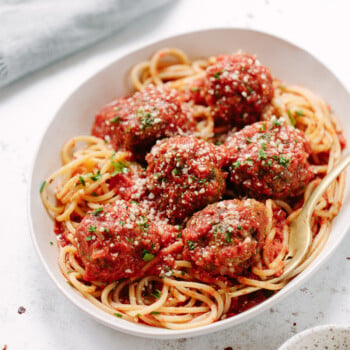
Classic Italian Meatballs (Tender and Juicy)

Ingredients
- ½ cup (54 g) fresh breadcrumbs, from 1-2 slices white bread (crust removed)
- ¼ cup (60 ml) milk
- 2 egg yolks
- ½ cup (50 g) grated pecorino Romano cheese, or Parmesan cheese
- 2 garlic cloves, finely chopped or grated
- 1 teaspoon (8 g) salt, or 2 teaspoons Diamond brand kosher salt (see note below)
- 1 teaspoon ground black pepper
- 1 pound (450 g) ground beef chuck
- 1 pound (450 g) ground pork, or veal
- ¼ cup grated onion, optional
- ⅓ cup (30 g) chopped parsley, or basil
- Olive oil
Instructions
- Put the breadcrumbs in a small bowl and pour the milk over. Let them soak for 5 minutes. Add the egg yolks, cheese, garlic, salt, and pepper to the bowl and mash together to form a coarse paste.
- Put the beef, pork and onion (if using) in a large bowl and mix with a fork to blend. Add the bread mixture and parsley. Blend everything together well, using your hands, large wooden spoon or large fork. You can also mix in a standing mixer on low speed, just until blended. The meatball mixture can be mixed and refrigerated 2 days ahead of shaping and cooking.
- Form the meatballs: Use a ¼-cup measuring cup or cookie scoop to portion the mixture and roll lightly into balls. They don’t have to be perfect — craggy meatballs have character and hold the sauce better!
To cook on the stovetop:
- Pour enough oil into a large skillet to coat the bottom and place over medium-high heat. When the pan is hot, add as many meatballs as will fit in the pan without crowding. Note: They should sizzle as soon as they hit they pan or the pan isn’t hot enough.
- Brown the meatballs on all sides. Cover the pan, lower the heat and continue cooking and until the meatballs are firm and cooked through (165 degrees on a instant thermometer), which should take about 15 minutes total. Repeat the frying with remaining meatballs, pouring out the oil and adding a fresh layer each time.To finish cooking in tomato sauce:If you'd rather finish cooking the meatballs in tomato sauce (my preference), transfer them to a pot of simmering sauce just after browning on all sides. They won't be cooked all the way through. Simmer until they're cooked through, 10-12 minutes.
To bake the meatballs:
- Preheat the oven to 425 degrees.
- Arrange the meatballs on an olive-oiled coated rimmed baking sheet. Bake 10 minutes, then turn the meatballs over with a spatula or pair of tongs. Continue baking until nicely browned and cooked through, another 10-12 minutes.
- Serve the warm meatballs with marinara sauce or your favorite prepared tomato sauce.
Notes
- To make fresh breadcrumbs: Trim the crust from a few slices of hearty country or Italian-style bread. Tear the bread into large pieces and pulse in a food processor until you see coarse pea-size crumbs or just tear them into pieces with your hands.
- To use dried breadcrumbs: Adjust the amount to 1/3 cup instead of the 1/2 cup of fresh crumbs. I recommend unseasoned dried breadcrumbs. If yours are seasoned, reduce the amount of salt in the recipe by 1/2 teaspoon.
- Panko: Use the full amount (1/2 cup), adding more by the tablespoon if the mixture doesn’t hold together
- Gluten-free breadcrumbs: Fresh or dried will work fine, following the tips above.
- Note on salt: Kosher salt has a larger grain than regular table salt. Because the granules are fluffier than fine salt, there’s less salt per volume in a teaspoon of kosher salt than there is fine salt. The brand of kosher salt that I use for all recipes on this site is Diamond Kosher. If you use Morton kosher salt or another brand of kosher salt other than Diamond, reduce the amount of salt specified by one-half.
- Meatballs can be made ahead and frozen up to 2 months. Cool the cooked meatballs completely. Arrange them in a freezer-proof container or heavy-duty freezer bag. Label the container with the contents and date. Defrost overnight in the refrigerator, then gently heat in your favorite tomato sauce on the stovetop..
- An electric standing mixer is handy to blend the meat and seasonings if you’d rather not do it by hand.
Nutrition per serving
Nutrition facts are calculated by third-party software. If you have specific dietary needs, please refer to your favorite calculator.
My father (and his father before him) used raisins in his meatballs too! I think I will have to make a batch with Raisins now.
We loved this dish! i added 1 large shallot, finely minced, it was an excellent touch of heat and flavor. all and all it was well worth the cook. Thank You Karen for the most amazing dish.
I love that you added shallot for extra flavor! Glad you enjoyed 🙂
I absolutely loved this recipe. The meatballs not only tasted superior. They were also moist. I would recommend this recipe to everyone . Thank you for sharing your recipe.
So happy you loved the meatballs!
These are the nicest meatballs I have ever tasted I highly recommend
Amazing and simple
These are the best meatballs I’ve ever had. My entire family loves them. They are very flavorful, moist, and super easy to make. The recipe is perfect as it is.
Absolutely delicious!
This recipe for meatballs was excellent. My family loved them so much that I’m making them again.
Only meatball recipe I use now. Every time I make them for others they ask for the recipe as well. Very simple and very delicious.
Made these tonight for dinner! They were delicious. I threw in some Italian seasoning to give it alittle more flavor. I also baked them in the oven to save having to slave over the stove. Saved this recipe and will make again.
Funny, but this is my identical meatball recipe. Maybe our mothers knew each other! 😀. Only difference is onions are mandatory!!
LOL! I just recently learned that the meatballs are actually my great-grandmother’s recipe, passed down to my mother! Sometimes my mother actually added chopped onion, but as a kid I did not like their crunchy texture 🙂
Thank you for the recipe. I made them exactly as it reads, and they were very flavorful, but not as tender as I had hoped. Maybe I’ll fry them next time vs. baking for the browning step.
Made them for dinner last night and they were delicious, this will be my go to from now on.
This recipe was good, but had WAY too much salt. If I make it again, I’ll cut the salt by half. Otherwise, the meatballs were good.
Hi Tim – Did you use regular table salt (1 1/2 teaspoons) or Diamond Kosher as indicated in the recipe? Table salt and even different brands of kosher salt, such as Morton, are saltier.
Can I use whole eggs instead of just the yolks?
Hi Nancy – Yes, you can use whole eggs. However, because the whites have more liquid, you might need to increase the amount of bread crumbs to thicken the meatball mixture so it holds together.
I have made meatballs for many years. i decided to try a new recipe, and this is OUTSTANDING!! Thank you for a 10 star recipe! Sally
So happy to hear that!!
I made the meatballs. We loved them. I cooked mine on the airfryer and they were perfect. How many meatballs is considered a serving when counting calories?
Jolene – I’m happy to know you enjoyed the meatballs! The calorie count listed is for one meatball.
I have made these multiple times and everyone always loves them!! I want to make some ahead of time and freeze. How do you suggest doing that? Should I pan sear them and then freeze? Then when I want to serve them, just let them simmer in some sauce for a while? Not sure what method is best.
Hi Shaye – Glad to hear you enjoy the meatballs! Follow these steps to freeze them: https://familystylefood.com/classic-italian-meatballs-2/#freezing
So I’m just recently discovering I totally enjoy cooking…I tried a meatball recipe a few weeks ago and it tanked in our house. So to redeem myself I used this recipe and it totally scored..thank you
These are authentic meatballs!!!! They came out so delicious!! I didnt have any leftovers. Im making it again tonight, we cant we wait to relive this deliciousness.