

Creamy Polenta with Parmesan Cheese
This post may contain affiliate links. Please read my disclosure policy.
Polenta was on my family’s table long before it became a restaurant menu staple. It looks pretty simple in the bowl, and it is — once you understand what it actually needs. Rush the heat, dump in the cornmeal all at once, walk away too soon, and you’ll end up with something lumpy and stiff. Use a heavy pot, low heat, and 35 (mostly hands-off) minutes, and you’ll wonder why you haven’t tried cooking it at home more often.
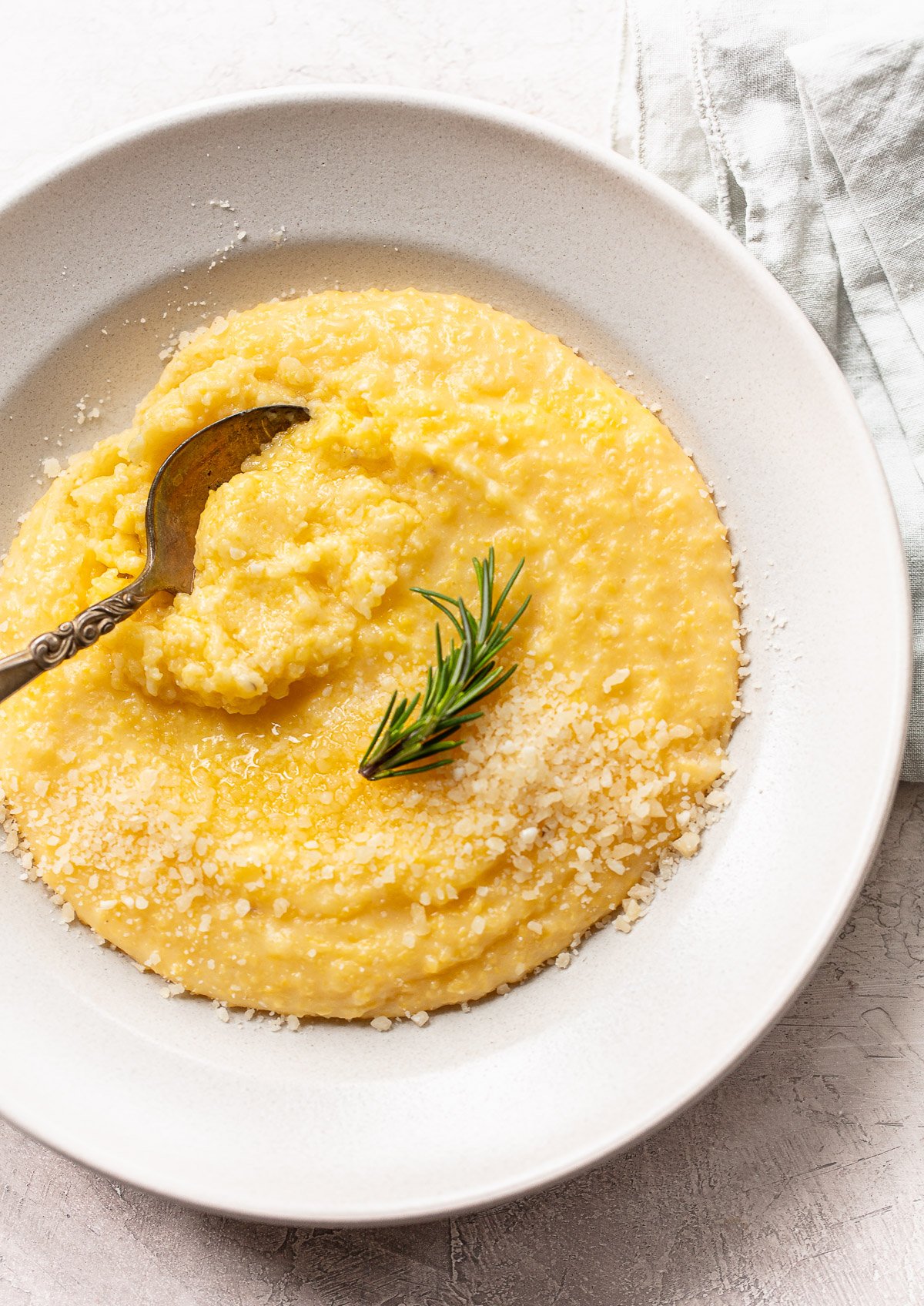
I’ve made polenta more times than I can count, and tested enough batches to know exactly where things go wrong. The fix isn’t complicated: The right cornmeal-to-liquid ratio, a heavy pot, and about 35 minutes of mostly hands-off cooking.
Why this recipe works
- The 5:1 liquid ratio. The standard polenta ratio is 4 parts liquid to 1 part cornmeal. Through testing I found that adding a fifth part — using a mix of water and milk — produces a noticeably creamier, more cohesive texture without making it heavy. The milk adds body, and the water keeps it from getting pasty.
- Low heat and a heavy pot. Polenta needs to steam and swell slowly, not boil hard. A Dutch oven or heavy-bottomed saucepan holds steady, even heat and prevents the bottom from scorching. High heat produces lumps and a sticky texture on the outside before the center has cooked through.
- Gradual pour, constant whisk. Dumping all the cornmeal in at once creates immediate clumping. Pouring in a thin stream while whisking gives each granule time to hydrate separately. Once the cornmeal is in, a brief whisk every 10 minutes is all it needs.
A few ingredients worth getting right
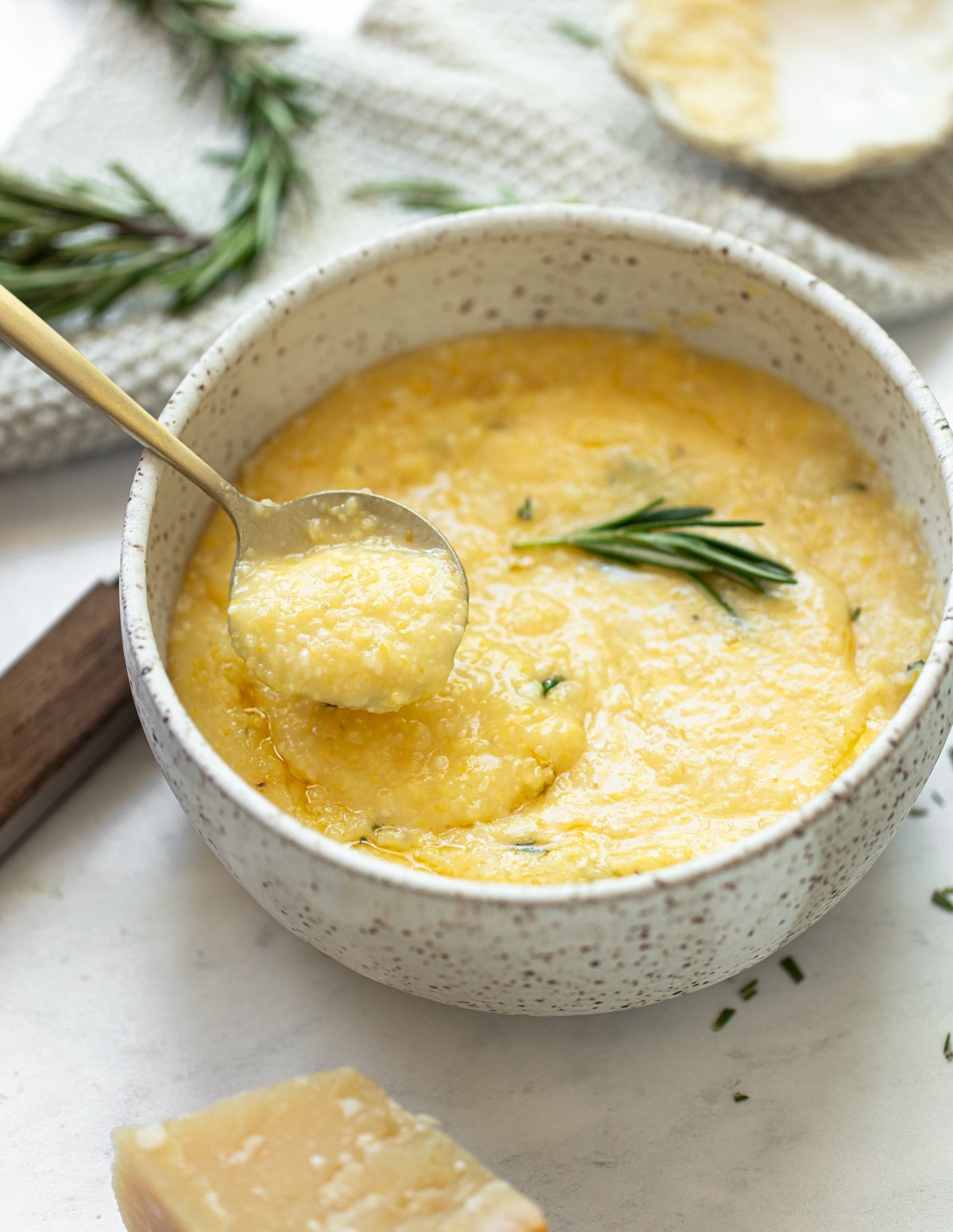
- Cornmeal: Polenta is made from medium or coarse-ground cornmeal — not the finely milled kind that’s more like flour. I use stone-ground or coarse cornmeal for the best texture and robust corn flavor. Fine-ground cornmeal is the most common mistake I see people making: It cooks faster but produces a gluey result that doesn’t improve with more cooking time..
- Butter: I use high-butterfat cultured butter when I can, and it’s worth it. The higher fat content — typically 82–84% versus the standard 80% — means more richness per tablespoon, and the cultured tang adds a subtle depth that plain butter doesn’t. You’ll notice the difference most in a dish this simple, where butter is doing real finishing work rather than disappearing into other flavors. Unsalted butter works fine if that’s what you have, just taste and adjust the salt at the end.
- Parmesan Cheese: If you can, use a chunk of Parmesan cheese and grate it yourself for the very best flavor. A good Parmigiano-Reggiano adds more than saltiness, it contributes the umami depth that makes this polenta so satisfying to eat on its own. I add it off the heat so it melts in without clumping. If you can’t find Parmigiano-Reggiano, Grana Padano is a solid substitute with a slightly milder flavor.
Types of cornmeal for polenta
- Stone-ground: My preference. It retains the hull and germ, which gives it deep corn flavor and a pleasantly rustic texture. Can be yellow or white.
- Coarse: Coarse cornmeal is somewhat gritty, similar to stoneground in that it has bits of grain visible. Coarse-ground cornmeal has a noticeable corn flavor and nubby texture.
- Medium: This type of cornmeal is ground to a finer consistency than coarse or stoneground kinds, with the kernel sifted out. If you prefer a super-smooth polenta and very creamy texture, this is the one to use.
How to make creamy polenta

1. Pour the cornmeal into the boiling liquid gradually, while whisking with your other hand. This is what prevents lumps from forming. 2. Keep whisking until all the cornmeal is incorporated and fully smoothed out. A heavy Dutch oven or saucepan (3–4 quarts) is ideal here — it holds steady heat so the polenta cooks evenly without scorching. 
3. Once the cornmeal is added, turn the heat to low, cover, and cook 25–35 minutes, stirring every 10 minutes or so. The polenta is ready when it pulls away from the sides of the pan and looks thick and fluffy.


3. Pull the pan off the heat before adding the butter and cheese — finishing off the burner keeps the fat from separating and gives you a smoother result. 4. Stir until the butter and Parmesan are fully melted and the texture is glossy and uniform. Taste here for salt before serving.


What to pair with polenta
- A fast weeknight dinner: Top polenta with simple marinara made from canned tomatoes and extra Parmesan. It comes together in the time the polenta takes to cook.
- Something earthier: Spoon over chunky mushroom ragu — it’s one of the most satisfying combinations on this site.
- Dinner party: Red wine braised short ribs are the move. The polenta absorbs the braising liquid — nothing else needed on the plate.
Creamy Polenta with Parmesan Cheese Recipe

Ingredients
- 4 cups (1 l) water
- 1 cup (250 ml) milk
- 1 ½ teaspoons kosher salt *see note on salt below
- 1 cup (160 g) coarse or medium-grind cornmeal
- 3 tablespoons (45 g) butter
- ½ cup (50 g) grated Parmesan cheese, plus more for serving
- 2 teaspoons chopped fresh rosemary or parsley, optional
Equipment
Instructions
- Bring 4 cups water and 1 cup milk to a boil in a 3-4 quart, heavy-duty sauce pan or small Dutch oven. Stir in the salt.
- Gradually sprinkle 1 cup coarse or medium-grind cornmeal into the pan — you can do this either by pouring it out of a small bowl or measuring cup with a spout, or with your hands, letting the grain fall through your fingers in a thin, steady stream while whisking at the same time. Keep whisking until all the cornmeal is incorporated and any lumps are smoothed out.
- Turn the heat to a very low simmer, cover and continue to cook the polenta for 25-35 minutes, and up to 45 minutes. Stir the polenta every 10 minutes or so. Be patient, and keep cooking until it's thick, fluffy and pulls away from the sides of the pan when you run a spoon around the edges.
- When it's done, remove from the heat and stir in 3 tablespoons butter, ½ cup grated Parmesan cheese and additional salt to taste if needed.
- Serve warm, sprinkled with 2 teaspoons chopped fresh rosemary or parsley and additional cheese.
Notes
- If you want fry or grill leftover polenta, reduce the amount of liquid in the recipe to 3 1/2 cups, which will produce a thicker consistency. To make polenta cakes, pour the freshly made hot polenta into a baking dish or sheet pan. Spread the top evenly, cool and refrigerate until firm. Slice or cut into portions with a cookie/biscuit cutter. Pan-fry in a cast iron or non stick pan with a little olive oil until brown on both sides.
- Use stock or broth in place of some of the water for richer flavor. Milk adds a somewhat creamier texture, but it can be substituted with your choice of water, stock or unsweetened plant-based milk if you prefer.
- Note on salt: This recipe calls for kosher salt, which has larger, fluffier granules and less sodium per volume than fine table salt. If you don’t have kosher salt, reduce the amount in the recipe by half.
Nutrition per serving
Nutrition facts are calculated by third-party software. If you have specific dietary needs, please refer to your favorite calculator.
I was hesitant to make Polenta, but I was absolutely amazed with this recipe. Thank you for sharing and making my first experience such a delight.
Wonderful recipe! Thank you!
Husband who favours the meat, vegetable and potatoe diet and pooh poohed the idea of “not eating that healthy rubbish” actually went back for seconds.
How can I make this an hour or two ahead of time to enjoy time with my guest before dinner?
Hi Paula – For just an hour or two, you don’t even need to refrigerate it! Make the polenta as directed, then keep it warm right on the stove. Turn the heat to the lowest setting (or turn it off, with the lid on) and give it a stir every 20-30 minutes. It’ll stay creamy and warm the whole time. If it thickens up a bit while it sits, stir in some warm water or milk to loosen it back up.
This is absolutely the best polenta recipe I’ve ever made! The low and slow really made a difference in the creaminess.
Loved this, and so did the hubby! Great recipe!
Easy and delicious
Followed your recipie & have eaten polenta with family & Italy over many years:& prefer it without grit of any kind what don’t suggest??
Hi Tamara – If you don’t enjoy the “grit” it’s because most polenta is made with coarsely stone-ground corn (literally called grits!). You could try using a slightly finer cornmeal, such as medium or fine ground. The only caution is that finely ground cornmeal can make a polenta with a pasty texture, and may need a bit more liquid to become creamy.
This polenta recipe is delicious! It’s like a warm comforting hug 🙂 Thank you!
That’s such a great description for the polenta! Thank you 🙂
Can you make it ahead and reheat?
Yes, you can make it ahead and reheat. But keep in mind that polenta naturally firms up as it cools, so the texture will be different than freshly made — it will be a little thicker. Add a splash of water, milk, or broth, and place on medium-low heat on the stovetop or in the microwave. Stir frequently as it heats to loosen it back up.
Would 1/2 and 1/2 work instead of milk?
Your picture instructions are quite different from the recipe one. In the pictures you have two sets of 24-30 min simmering times, in between which you add butter and cheese, which adds up to at least 50 minutes. In the recipe, there is only one simmering session, you add butter and cheese and then your’e done.
Hi Vivi – Yes, I see that the photos were out of order – thank you for noticing that! Cooking time after adding the liquid is around 30 minutes.
Took me around 50 minutes to set
Hi, Karen,
I’m new to your recipes. I see a note about How Many servings a recipe serves, but not what SIZE a serving is.
As a diabetic, the serving size is important.
“Ricardo” asked for this as well, but I didn’t see an answer.
Am I missing that info somewhere?
Hi Laura, My polenta recipes makes about 6 1-cup servings. I am not a dietician, so I include a note in all of my recipes that nutrition info is calculated by a third party, not by me. Considering your very specific health needs, I suggest that you use your own calculator or app to input the ingredients.
Made this recipe as listed but added 4 oz cooked pancetta and a ½ cup of toasted pine nuts. A great side dish or under-dish for salmon or beef.
If I can make polenta using this recipe, how can I reheat it later?
Hi Rae, If you want to make it ahead and reheat later, transfer the freshly cooked polenta to a 3-4 quart baking dish, sprinkle the top with some Parmesan, cover and refrigerate. Reheat it in a 350 degree oven (covered) until it’s heated through, about 20 minutes depending on your oven. The texture of the polenta will firm up as it cools.
This recipe is so good and easy! The polenta is very creamy and even delicious as leftovers.
This recipe is a keeper!
I made this for Christmas Eve and everyone loved it. I’m making it again tonight. It’s so creamy and delicious. I can’t wait to try it with broth.
Even though I sprinkled the cornmeal in the boiling water and milk, It formed lumps and although it had great flavor, I didn’t like the lumpy consistency. How can I prevent this next time I make it? Also, what do you mean by cook it until? “it pulls away from the side of the pan“?
Oh no, I’m sorry your polenta was lumpy instead of creamy! The trick to removing any lumps is to keep whisking until all the cornmeal is added, and continuing to do so until it smooths out. I’m going to update the directions to make that clearer. As to your other question: Have you made bread dough in a mixer? There’s a point when the flour and wet ingredients are no longer a batter.That’s kind of what happens when polenta thickens. It won’t form a ball like dough does, but when you run a spoon around the edges of the pan it will look cohesive rather than soupy. I hope that makes sense!
I love this recipe but for dietary purposes could you please start adding in grams/ounces the size of each portion? Thank you
*****
I LOVE this polenta recipe. I’ve made it before and it’s in the pot now! The family loves it too! Kudos, Miss Karen!!
Hi Joyce that’s wonderful!