

Homemade Chicken Broth, Fresh and Simple
This post may contain affiliate links. Please read my disclosure policy.

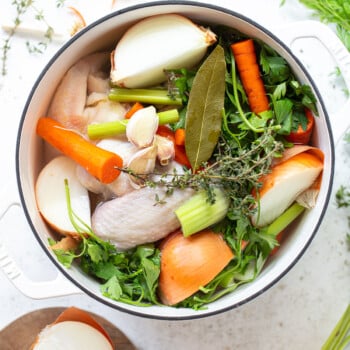
A basic homemade chicken broth to keep stashed in your fridge and freezer. Use it in soup recipes, add to pan sauces, or to enrich the flavor of just about everything you cook. Simmers on the stovetop for 3 hours, or cooks in 1 hour in an electric pressure cooker.

Making chicken broth from scratch doesn’t take much time, but the difference between homemade and the boxed version is immediately obvious — in flavor, color, and the way it makes everything you cook with it taste better. Even homemade vegetable broth has that quality that no carton can replicate. Once you’ve tasted the real thing, it’s hard to go back.
Chicken broth vs chicken stock
One of the very first things taught to beginner cooks in culinary school is how to make stock. Whether made from beef, chicken, fish, or vegetables, a well-made broth is a magical elixir — the foundation of flavor in virtually every cuisine.
Chicken broth and chicken stock are largely interchangeable terms. The real difference comes down to cooking time: Bones for stock are often roasted before simmering and cook considerably longer, producing a deeper, more gelatinous result.
Karen’s ingredient notes

The best chicken broth recipe will reward you with a flavorful, but neutral, background for building soups and other dishes. Since broth usually goes into such things as a homestyle chicken soup or my very personal take on Italian wedding soup with meatballs, it’s best to keep a light hand with seasonings, such as salt or stronger-flavored vegetables.
- Chicken parts: To make about 3 quarts of chicken broth, you’ll need 3 pounds of chicken parts (remember this 1:1 ratio if you want to scale the recipe up or down). I prefer chicken wings because they contain the perfect proportions of meat, skin and fat. Instead of wings, you can also use chicken backs, necks, carcasses or an assortment. Note: Don’t include giblets, because they will make the stock cloudy and muddy-tasting. Use the leftover carcasses from a roasted chicken. Stick them in a bag in the freezer and make stock when you’ve accumulated enough.
- Vegetables: Carrots, celery, onion and garlic form a classic aromatic base for broths. I stick to those, resisting the urge to clean out the vegetable drawer. Root vegetables like turnips and beets are a no for me — they release a sulfurous aroma that will follow the broth into everything you make with it. Starchy vegetables like potatoes dissolve slightly into the liquid, clouding it and pushing the flavor toward sweet rather than savory.
- Herbs: Parsley, thyme, and bay leaf each do a specific job. Parsley contributes a clean, green background note and is partly responsible for the broth’s golden color — use the whole bunch, stems and all. Thyme is more aromatic, releasing a subtle, almost piney quality that complements poultry particularly well. Bay leaf is an anchor: It doesn’t assert itself the way the other herbs do, but it reinforces and rounds out the base notes of everything simmering around it.
Chicken broth cooking steps

1. Add the chicken parts, vegetables, herbs and water to a large pot. Simmer for 3 hours. 
2. Set a fine mesh strainer or a colander lined with cheesecloth over a large bowl and strain. Tip: Tuck the edges of the cheesecloth into the bowl to keep it from slipping.

Using chicken stock solids
The cooked pieces of chicken and vegetables in a broth tend to be past the point of tasting good, and the texture can be unpleasantly mushy. But you don’t have to just throw them away. Pick the meat off the bones and vegetables and reserve separately. It can be repurposed into a soup or casserole meal.

Homemade Chicken Broth, Fresh and Simple

Ingredients
Yield: About 3 quarts
- 3 pounds (1.35 kg) raw chicken wings, or a combination of wings, backs and raw or leftover cooked carcasses
- 3 carrots, cut into 3-inch pieces
- 3 stalks celery, cut into 3-inch pieces
- 1 onion, unpeeled and cut into quarters
- 3 cloves garlic, unpeeled and lightly smashed
- ½ bunch fresh parsley, rinsed
- 1 bay leaf
- 4 sprigs fresh thyme, optional
- 12 cups (2.80 l) water
Equipment
Instructions
- This recipe yields about 12 cups (3 quarts) of chicken broth. Scale it up or down as needed, using a 1:1 ratio of chicken per quart of water.
Stovetop method
- Put the chicken parts in a large stock pot. Add the carrots, celery, onion, garlic, parsley, bay leaf and thyme sprigs. Pour the water into the pot and place over medium-high heat. If the water doesn't completely cover everything by at least an inch, add a bit more.
- Bring to a boil, then immediately lower the heat to medium-low. Simmer the broth at a gentle bubble for 3 hours, without stirring. To ensure a clear (not cloudy) broth, keep your eye on the heat throughout the cooking to be sure the liquid doesn't come back to a full boil.
- Spread a piece of cheesecloth over a colander, and set the colander over a large bowl. If you don't have cheesecloth, choose a fine mesh strainer. Strain the broth into the bowl and cool to room temperature. Transfer the broth to storage containers and refrigerate.
Pressure cooker (such as Instant Pot) method
- Add all ingredients to a pressure cooker pot. Be sure the water doesn't come more than ⅔ of the way up sides of the pot. Cook on high pressure for one hour. Release the pressure naturally. Strain, cool and store the broth as directed above.
Notes
- Refrigerate for up to 5 days, or freeze for up to 3 months. Freeze in 1 or 2-cup portions.
- To cool broth quickly (especially when making larger quantities), immerse the bowl of strained broth in an ice bath set up in the sink or a roasting pan.
- Once the broth has chilled completely in the refrigerator, remove the layer of fat the forms on the surface. Save the fat if you like— it can be used as a cooking oil or added to soup.
- It’s normal for the chilled broth to resemble a gel in consistency, which comes from the natural collagen in the chicken bones that’s released during cooking.
- I don’t usually add salt to chicken broth. Because the liquid broth will be reduced later in sauces and other dishes, the salt will become more concentrated. It’s easier to adjust the seasoning later.
Nutrition per serving
Nutrition facts are calculated by third-party software. If you have specific dietary needs, please refer to your favorite calculator.



Can you use the chicken wings after?
This homemade chicken broth recipe is incredibly helpful and comforting! I really appreciate the detailed tips for getting rich flavor naturally at home. Homemade broth always tastes so much better than store-bought versions, and this recipe makes the whole process feel easy and approachable. Perfect base for soups, sauces, and cozy meals.
I made this, excellent flavor. I just made a small batch, as I cook for 1, and it smells amazing!
Onions (and onion powder) are very toxic to dogs also.
No salt ???
Hi Mel – You can go ahead and add 1/2 teaspoon of salt to the broth ingredients as it cooks. I don’t usually add more than that to the initial broth mixture, because sometimes the next use for broth is in a sauce or stew, where the broth will reduce and then taste much saltier. If you’re going to be using the broth as is after cooking, taste it and add more salt to your taste.
Luck has me living near a chicken butcher who supplies me with as much chicken bones as I wish. I buy five pounds of bones and one turkey leg sans skin cut into four pieces. In a large eight-quart pot, I combine these bones, carrots, onion, celery, salt, black pepper, bay leaf, and six quarts of fresh filtered water.
After cooling my chicken stock, I removed the fat top layer to discover the it had all turned to gel. What happened? can i use this?
Hi Susan, That’s such a great question! It’s perfectly normal that your broth thickened to a gel-like texture. The reason it happens is that collagen from the chicken bones is released during the cooking process, creating a natural form of gelatin — that’s exactly what you want in a rich and flavorful stock! It thickens when chilled, but will completely melt away once it’s heated.